Recombinant protein production
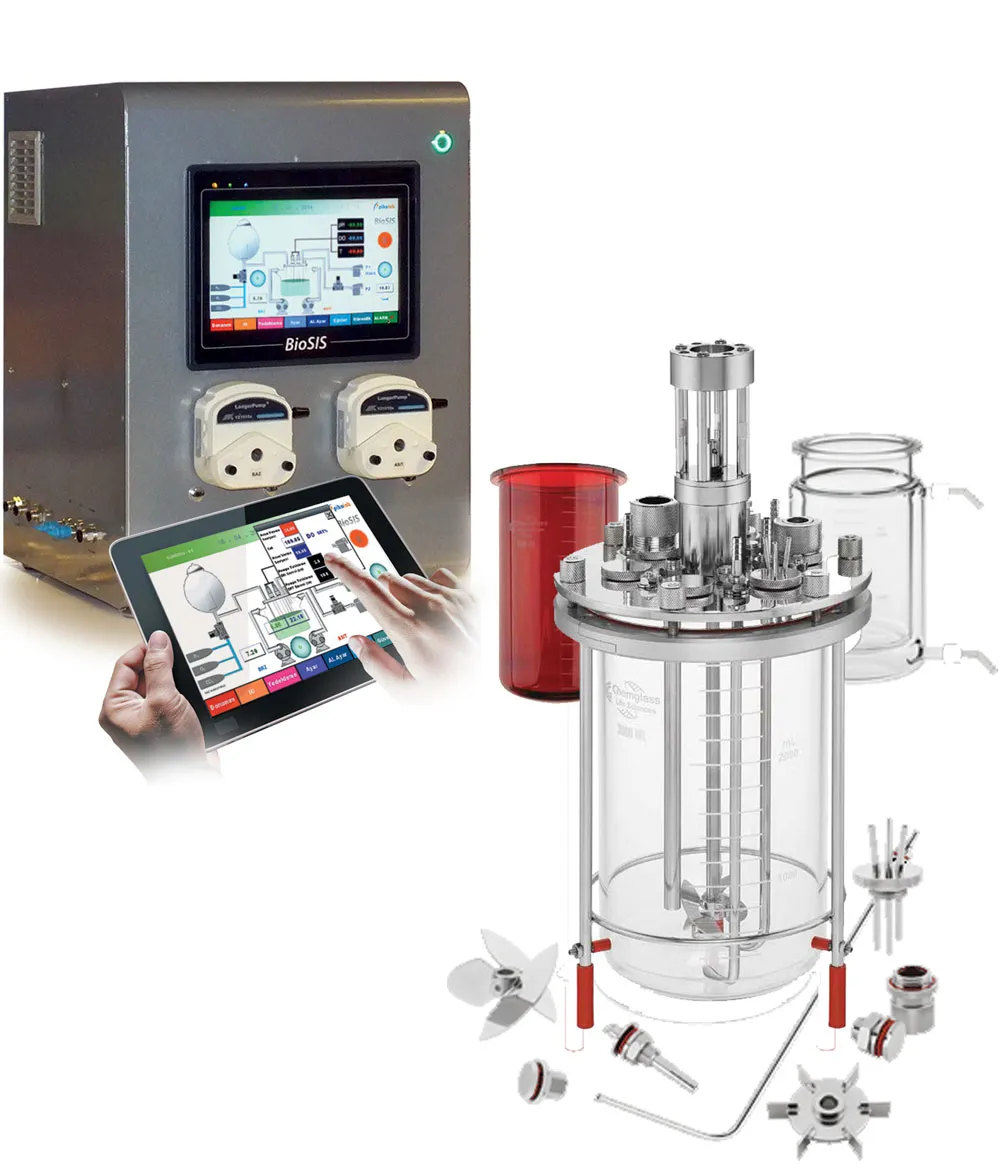
Recombinant enzymes, food proteins and research proteins are often produced in Escherichia coli, Komagataella phaffii (Pichia pastoris) or Bacillus strains. With inducible promoters, production has two phases: a growth phase in which biomass is brought to high cell density, and an induction phase in which product synthesis is started. At high cell density, oxygen demand and metabolic heat load rise; in this phase the oxygen transfer and cooling capacity of the reactor become limiting.
Application-specific process requirements
Growth phase and feeding
In the growth phase, substrate is fed on an exponential profile that keeps the specific growth rate below the overflow metabolism limit; in E. coli processes this limits acetate accumulation. The feed profile is entered on the control unit and applied with peristaltic pumps. Feeding linked to the dissolved oxygen signal (DO-stat) is evaluated within the project.
Induction
In E. coli processes, induction is mostly carried out by adding IPTG or lactose; the temperature is often lowered at induction to increase the soluble fraction of the product. In K. phaffii processes with the AOX1 promoter, methanol feeding follows the glycerol phase; the methanol concentration is limited so that it does not reach levels toxic to the cells. Temperature and feed changes at induction are defined as set point changes on the control unit.
Methanol-fed processes
Methanol is a flammable liquid. For methanol-fed processes we evaluate the explosion protection (ATEX) requirements for storage, the feed line and exhaust gas within the project.
Oxygen transfer and heat removal
When oxygen demand cannot be met by air flow and agitation speed, oxygen-enriched air and vessel pressure are used; on Talamus systems these options are defined within the project. Metabolic heat is removed through the jacket; on the TLM500, temperature is also controlled through the jacket. Cooling capacity depends on the cooling water inlet temperature.
Production methods used
Talamus models for this application
| Model | Scale | Working volume | Sterilisation | Delivery | Control structure |
|---|---|---|---|---|---|
| TLM Lab | Laboratory systems | Laboratory scale; vessel volume and number of parallel reactors per configuration | Autoclave | Benchtop | Shared loop and data structure |
| TLM120 | Pilot-scale systems | 20 L seed reactor + 100 L pilot reactor | Automated SIP | Skid-mounted | Shared phase, loop and data structure |
| TLM500 | Pilot-scale systems | 500 L working volume (600 L total) | Automated SIP | Skid-mounted | Shared phase, loop and data structure |
Technical consultation request
Information on the expression system, target protein, induction method, target cell density and biosafety level is sufficient for an initial assessment.